

Guide: Publish in Open Access

Open access goes beyond the simple right to read for free; it gives authors the power to decide how their work is reused and exploited. This control is managed through the use of Creative Commons licences, which ensure the visibility and impact of research in a legal and secure manner.
There are various ways to publish under this model. In this guide, we help you identify which is the most suitable for your work and how to ensure compliance with the requirements set by funding bodies.
Options for publishing in Open Access
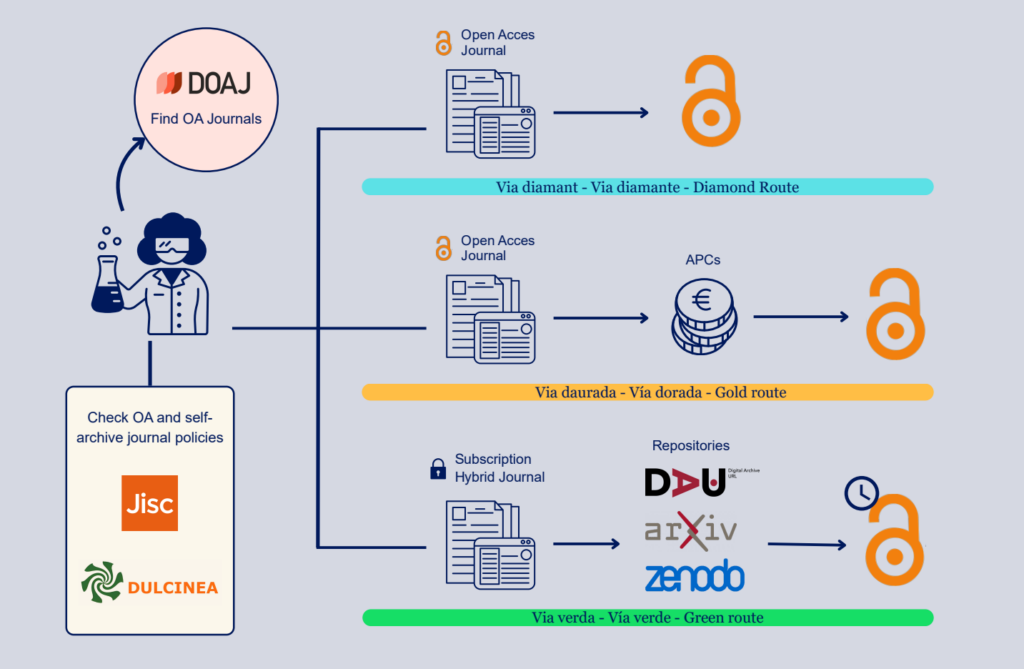
Publishing under cost – Golden Route
Arrange for Open Access publication directly with the publisher and cover the cost of the APC (Article Processing Charge). We recommend that you check the transformative agreements available on IQS Library to cover this cost.
Publish for free – Diamond Route
Publish openly directly at no cost to the author. You can check the DOAJ for a list of diamond-rated journals that do not charge an article processing charge (APC).
Deposit in DAU or other repositories – Green Route
If you do not have the funds to cover the cost for immediate open access publication, the Library will make the postprint (Accepted Author Manuscript) openly available in the institutional repository, always in accordance with the publisher’s criteria and embargo periods.
Plan your Open Access Publication
Before deciding where to publish, check your funding agency’s requirements regarding Open Access and Creative Commons (CC) licences.
Which routes and licences do they accept?
Currently, funding agencies not only require that publications resulting from funded projects must be made available openly, but also specify the type of licence under which they must be published (usually the most permissive ones, such as CC BY).
- If you are required to publish directly in Open Access (Gold and Diamond Route)
Check on DOAJ whether the journal offers Open Access publishing, which CC licences it applies, and what is the APC cost. Consider any transformative agreements available at IQS to cover the cost. - If you are required to deposit in a Repository (Green Route)
The IQS Library will deposit your publications with IQS affiliation in the DAU institutional repository. Ensure that the chosen journal permits deposit and under the following conditions:
- If the publication is Open Access (OA): The publisher’s version (Version of Record) is deposited under the same original CC licence.
- If the publication is subscription-based (restricted): The Accepted Author Manuscript (postprint) is deposited under the licence specified by the publisher and, where applicable, the embargo period is applied (usually 6–24 months). Check policies on Jisc – Open Policy Finder or Dulcinea to confirm the version, licence and embargo.
Agencies with an Open Access mandate
Horizon Europe (2021-2027) Horizon 2020 (2014-2020) Ministerio de Ciencia, Innovación y Universidades More information
Open Access publication Routes
There are various Routes to Open Access publication. It is essential to choose the one required by your funding agency or, where applicable, the one that best suits your research.
Direct publication in a Journal
- Diamond Route: Open Access Journals without costs for authors, Article Proceeding Charge (APC) and free access to the publication for readers.
- Golden Route: Journals that offer a hybrid or full open publications method under the payment of an Article Proceeding Charge (APC) from the author, the publication can be published in Open Access. Once paid, the publication is open and published under a CC License (usually CC BY).
In IQS Library we offer transformative agreements that cover the full or partly costs of the APC with different publishers.
Repository publication – Green Route
This is used when you publish in a subscription-based journal (restricted access) or if your funding agency requires repository deposit.
- Self-archiving: an authorised version of the article —usually the Accepted Author Manuscript (post-print)— is deposited in an institutional (DAU) or subject-specific repository.
- Conditons: The version may be subject to a temporary embargo and a specific licence depending on the publisher’s policy.
- Consulta de políticas: Verify which version you can archive and when on platforms such as Jisc – Open Policy Finder or Dulcinea.
More information: Guide: Publication Deposit in DAU
© 2026 by Biblioteca IQS is licensed under CC BY 4.0
Once you are aware of your funding agency’s requirements and the available publication options, use these tools to select the most suitable journal:
Directory of Open Access Journals (DOAJ)
Search for OA journals by subject, title, publisher or licence, and check the transparency of their policies to distinguish between the Diamond (no-cost) and Golden models.
Actions:
- Check the CC licence accepted by your funding body.
- Check the APC and whether coverage is available through transformative agreements.
- Review indexing, subject scope and editorial timelines (if the journal provides them).
Editorial Policy Finder (Jisc – Open Policy Finder / Dulcinea)
If you opt for the Green Route, confirm which version you can deposit in the DAU Repository, when and under which licence:
- Permitted version: preprint, AAM (postprint) or VoR (editorial version).
- Embargo periods: standard timeframes set by the publisher.
- Licences: specific conditions for deposit and reuse.
If applicable, ask us to deposit your article in DAU.
Quick tips
- Prioritise journals with transparent policies (licence, APC, deposit).
- Align the licence and route (gold/green/diamond) with your funder’s requirements.
- Before submitting, check whether the APC can be covered by transformative agreements.
Creative Commons Licences
Creative Commons licences legally allow authors to retain their copyright and not transfer it to publishers. The licences are always based on the basic condition that the work must be specifically acknowledged and cited (CC BY), with the following possible conditions added:
- NC – No comercial (No commercial): the work may be copied, distributed, displayed and used to create derivative works for non-commercial purposes.
- ND – No derivadas (No derivatives): the work may be copied, distributed, displayed and performed, but no derivative works may be produced.
- SA – Compartir igual (Share Alike): derivative works may be distributed under a licence identical to that of the original work.
| License | Description of rights | Summary |
|---|---|---|
CC BY
|
This license allows reusers to distribute, remix, adapt, and build upon the material in any medium or format, provided that credit is given to the creator. The license allows commercial use. |
|
CC BY-SA
|
This license allows reusers to distribute, remix, adapt, and build upon the material in any medium or format, provided that credit is given to the creator. The license allows commercial use. If you remix, adapt, or build upon the material, you must license the modified material under the same terms. |
|
CC BY-NC
|
This license allows reusers to distribute, remix, adapt, and build upon the material in any medium or format, solely for noncommercial purposes, and provided that credit is given to the creator. |
|
CC BY-NC-SA
|
This license allows reusers to distribute, remix, adapt, and build upon the material in any medium or format, solely for noncommercial purposes, and provided that credit is given to the creator. If you remix, adapt, or build upon the material, you must license the modified material under the same terms. |
|
CC BY-ND
|
This license allows reusers to copy and distribute the material in any medium or format only in its original form (without adaptation), and provided that credit is given to the creator. The license allows commercial use. |
|
CC BY-NC-ND
|
This license allows reusers to copy and distribute the material in any medium or format only in its original form (without adaptation) and only for non-commercial purposes, provided that credit is given to the creator. |
|