

Guide: Learn About Open Science

What is Open Science and Open Access?
Open Science is a comprehensive movement that seeks to ensure unrestricted access to and increase the reuse of the outputs generated by scientific research, including publications, data, methodologies, software and other resources.
Meanwhile, Open Access emerged as an alternative to the traditional publishing model, promoting free access to publications. This involves publishing without ceding rights to publishers, allowing reuse under open licences and ensuring free access via repositories.
The CSUC offers an online course for research staff to learn more about the new Open Science paradigm.
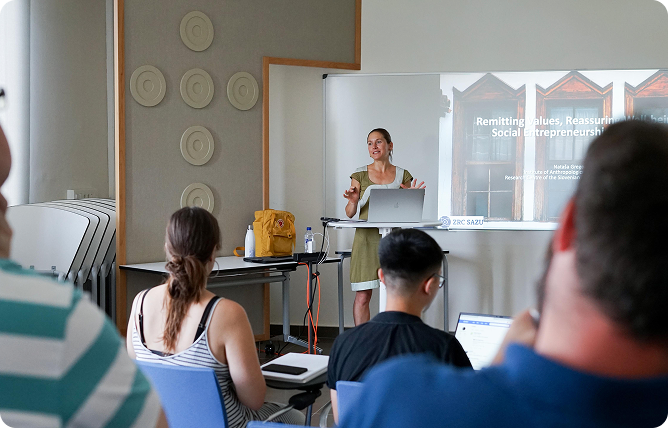
Photography from UNESCO Recommendation on Open Science
Open Science Dimensions
Within the current framework, there are several ways to publish in open access. These are described in the Budapest Declaration on Open Access and other subsequent initiatives. Below, we explain the main options available:
- Diamond Route: Publication in open-access journals that are free of charge, with no fees levied on either the reader or the author. Open licences such as Creative Commons are used. These journals are usually supported by universities, public bodies or scientific societies.
- Golden Route: Direct publication in scientific journals that offer open access from the moment of publication. Access is free of charge for the reader, but involves a payment by the author or their institution, known as an APC (Article Processing Charge). They usually use open licences such as Creative Commons, which allow the content to be shared and reused.
Important note: Even if you publish via this route, many funding agencies require you to also deposit the article in an institutional repository (green route). - Bronce Route: Acceso libre al artículo por un tiempo limitado desde la página de la editorial, pero sin una licencia clara que permita su reutilización. Free access to the article for a limited time via the publisher’s website, but without a clear licence permitting its reuse.
- Green Route: This involves depositing a copy of the article in an institutional or subject-specific repository, even if it has been published in a traditional (paywall) journal or as open access. It provides free and open access for both the reader and the author.
Types of versions that can be submitted:
- Author Accepted Manuscript (AAM – postprint): A peer-reviewed version that has not yet been formatted by the publisher.
Important note: Always keep your postprint if your publication is not published openly, as this is the document that will enable you to comply with the Ley de la Ciencia without incurring additional fees. - Published Version: The final version published with the publisher’s own formatting.
Restrictions: Some publishers impose an embargo period (between 6 and 24 months) before allowing open access to the AAM.
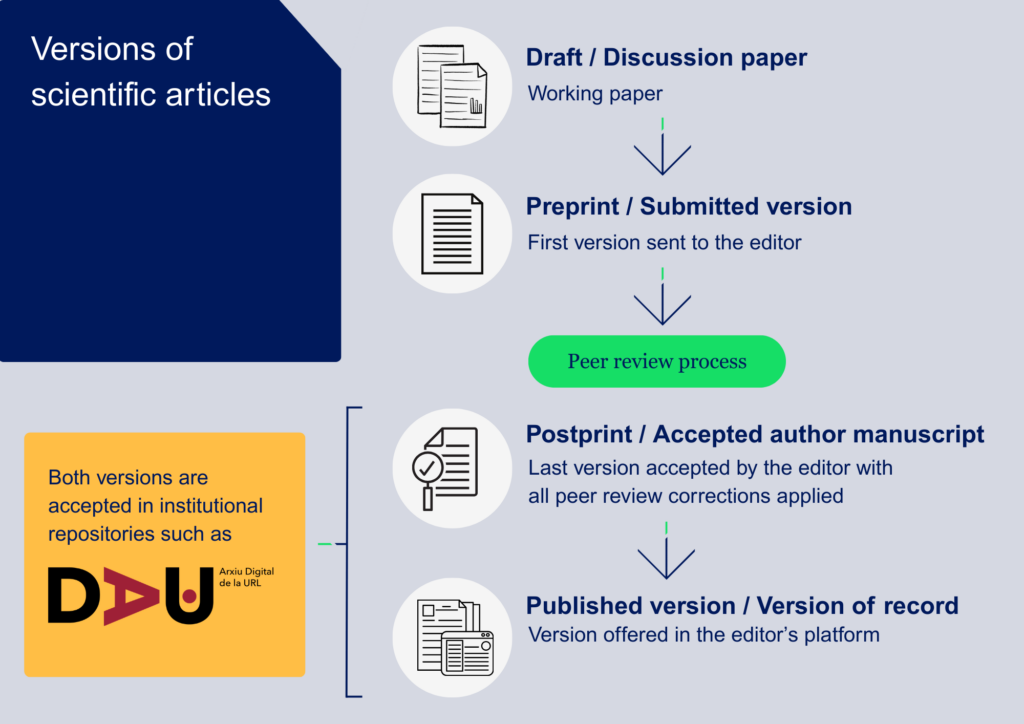
Versions of scientific articles © 2026 by Biblioteca IQS is licensed under CC BY 4.0
At IQS, you can use our DAU Institutional Repository for this purpose. Guide: Publication Deposit in DAU
For more information on the specific steps to follow to publish in open access at IQS, please visit:

Funding bodies and agencies now require open access to publications as well as to the research data collected, used and generated during the research project.
The aim is to publish research data in open repositories with the greatest possible degree of openness, in accordance with the FAIR principles (findable, accessible, interoperable and reusable).
The research data management process requires an understanding of what research data is, its lifecycle, how to manage it, and how to draw up a Data Management Plan.

Another cornerstone of open science is open-source software and the open sharing of source code in repositories. Among the best known are Zenodo and GitHub.

Citizen science, as part of open science, aims to enable the public to participate directly in the research process, either by conducting research or by taking part in scientific projects.
European Citizen Science brings together descriptions of European projects that seek public participation in the development of their projects.
AQU and ANECA have signed up to the Coalition for Advancing Research Assessment (CoARA) and the San Francisco Declaration on Research Assessment (DORA) to promote a more open, accountable and diverse culture of assessment, one that recognises all forms of research output – including data and software – and takes their social impact into account.
This development is reflected in:
- Recognition of new types of outputs
A wider range of contributions are valued: data, software, reports, technical or artistic works, exhibitions, archaeological excavations or conference contributions, amongst others. - Metrics with greater context and impact
Indicators beyond the traditional ones are incorporated, providing disciplinary context, information on the dissemination and social impact of the research, with a qualitative interpretation of the results. - Narrative justification of merit and impact
A narrative justification is required to contextualise the quality, relevance and impact of the contributions (not just their quantity), aligned with the objectives and specific characteristics of the discipline.

Open Educational Resources (OER) are learning, teaching and research materials in any format or medium, published under an open licence that allows third parties to access, reuse, repurpose, adapt or redistribute them free of charge.
Educational repositories
Learn about Open Science
Tools and Repositories
DOAJ
DOAJ is an international, curated directory of open-access scientific journals (it includes those that meet quality and transparency criteria, not all existing journals).
What it tells you about each journal:
- Subject area, title, publisher, country and language.
- Whether an article processing charge (APC) is payable (amount and currency) or it is a diamond open access journal (no APC).
- Publication licence (e.g. Creative Commons) and who holds the copyright (authors or publisher).
- Additional information: peer review, preservation, self-archiving policies (if stated by the journal), etc.
Use it for:
- Filter by discipline and licence compatible with your funding body.
- Identify journals that are free of charge or have transparent open access policies.
Jisc – Open Policy Finder
Formerly known as SHERPA/ROMEO, this platform centralises and summarises the self-archiving policies of publishers and journals. It allows users to search by journal, publisher or funder and check compliance with open access and transformative licensing agreements.
For each paper version Submitted (preprint), Accepted (AAM or postprint) and Published (VoR or editorial version), it specifies:
- Required payment for Open Access, permitted licenses, embargo periods and deposit locations (e.g. institutional/subject repository).
- Specific conditions (acknowledgement, DOI, links).
Use this to:
- Check if you publish under a subscription model, which version you can deposit in the DAU and under which licence and if there’s an embargo period.
- If the journal follows the Open Access requirements of your funder.
Zenodo – General Repository
A useful repository for depositing publications by authors affiliated with organisations external to IQS or Ramon Llull University. Deposit the preprint (submitted), postprint (Author Accepted Manuscript) or published version in a general-purpose open-access repository, in accordance with your journal’s publisher’s guidelines. Check the guidelines on Jisc – Open Policy Finder.
Subject-specific repositories
Subject-specific repositories are useful for depositing preprints that are not suitable for deposit in DAU, as well as publications from authors affiliated with institutions external to IQS or the Universitat Ramon Llull. Consult the Jisc Open Policy Finder to find out under what conditions and which versions of your publication you can deposit in the following repositories:
eiNa DMP
A Data Management Plan (DMP) is a document that sets out all the data collected during the course of a scientific research project funded by public money.
To create this document, we recommend using eiNa DMP, where you can store, update and share the information, and save it in the format of your choice.
Acces eiNa DMP Manual ‘How to elaborate a DMP with CORA.eiNa DMP’
Cora.RDR
The Universitat Ramon Llull (URL) participates in the Catalan Open Research Area Research Data Repository (also known as CORA.RDR), the trusted repository for research data from Catalan universities and CERCA centres. It is the recommended service for publishing open data with guarantees.
The metadata for datasets published in the RDR are indexed in Google Dataset Search, DataCite Search, OpenAIRE and Mendeley Data, and comply with the FAIR principles (findable, accessible, interoperable and reusable).
The data is disseminated as datasets that include:
- Files containing the research data.
- Persistent identifier (e.g., DOI).
- Description of formats used.
- Descriptive metadata and README file.
- Additional contextual documentation, where applicable.
Access Cora.RDR Manual ‘RDR, the repository where to publish FAIR data’
Learn about Open Science
Funding agencies that promote Open Science
Open science requirements for publications according to publication method
- Direct open access publication: the published version must be deposited immediately in a repository under a CC BY licence or equivalent (for long-text publications, the licence may exclude commercial uses and/or derivative works).
- Publication via subscription or paywall: you must immediately deposit the postprint version (accepted author manuscript, accepted version) via a repository licensed under CC BY or an equivalent licence. For monographs, the licence may exclude commercial use or derivative works. You must check that the publisher’s embargo period for the accepted version is compatible with this requirement. Check this on Jisc – Open Policy Finder.
Guide: Publication Deposit in DAU Further details of the requirements
Requisitos de ciencia abierta para publicaciones según el método de publicación
- Direct open access publication: immediate deposit of the published version via a repository is required. Proceed to Deposit publications in DAU.
- Subscription or paywall publication: immediate deposit of the postprint version (accepted author manuscript, accepted version) via a repository is required, offering open access within a maximum of 6 months for LS and PE or 12 months for SH after publication. You must check that the publisher’s embargo period is compatible with this requirement. Check this on Jisc – Open Policy Finder.
Guide: Publication Deposit in DAU Further details of the requirements
According to the criteria of the call for proposals, it is stipulated that beneficiary organisations must make research results available via open access.
- Publications: open access can be provided directly through the journal or by depositing them in institutional repositories within six months of publication.
- Data: must be deposited in an institutional repository within two years of the project’s completion.