


Guide: Alternative Metrics

As the name suggests, alternative metrics are emerging as different methods for assessing the impact of research results, thereby complementing traditional metrics.
Alternative metrics aim to highlight the impact of research results beyond the scientific community itself, extending it to broader social spheres within the network.
The main tools for searching for and tracking alternative metrics, both available on MERIT, are:

List of Available Metrics
Altmetric provides the number of mentions across various social media platforms and media outlets. You can find the complete list here:
- Policy documents
- Clinical guidelines
- Noticias New outlets
- Blogs (academic or not)
- Reference Managers (Mendeley y CiteULike)
- X
- Bluesky
- Patent citations
- Wikipedia
- YouTube
- Citations (Dimensions)
The following section explains how the various metrics are presented and how to use the tool to draft narrative justifications.
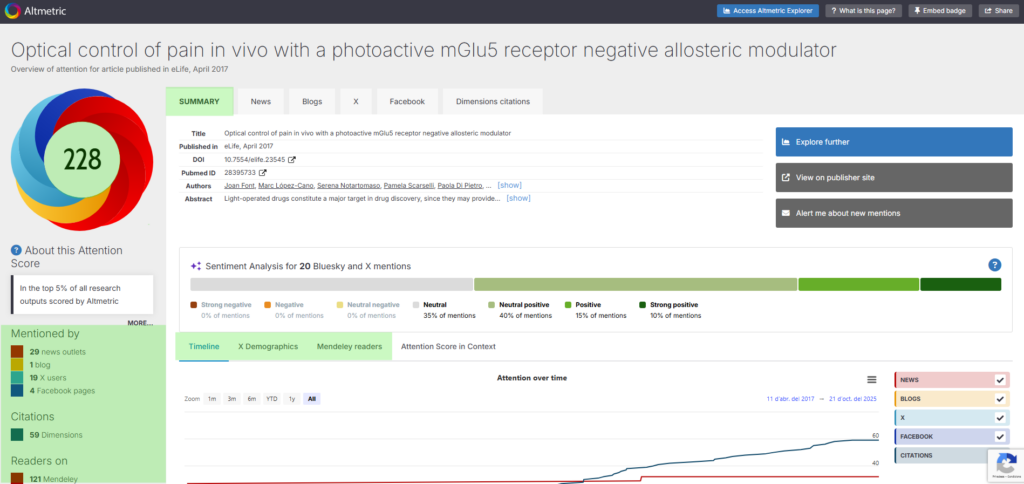
Altmetrics score
A metric that measures how much attention a scientific publication has received in media outlets such as news reports, social media, blogs, etc. Each mention is weighted differently: for example, a newspaper article carries more weight than a tweet. In addition, the system avoids counting repeated mentions by the same person and adjusts for the quality of the source. This yields a number that reflects public interest in that research output.
Altmetrics provides headlines that put this value into context in About this Attention Score and Attention Score in Context (Summary).
Summary
This section provides an overview of the article’s impact. It displays basic bibliographic data and the number of mentions it has received on various platforms, such as social media, news sites, blogs, and Wikipedia. It offers a quick way to see how much attention the work has generated and where it has been discussed the most.
Timeline
The timeline lets you see when the article generated the most attention. This way, you can tell whether interest was immediate or whether it emerged later—perhaps because of a related event or because someone shared it on a key date.
X Demographics and Mendeley readers
The demographics and geographic distribution of X and Mendeley users who have cited the publication are shown.
Narrative
- About this Attention Score: Summary of the publication’s main achievements.
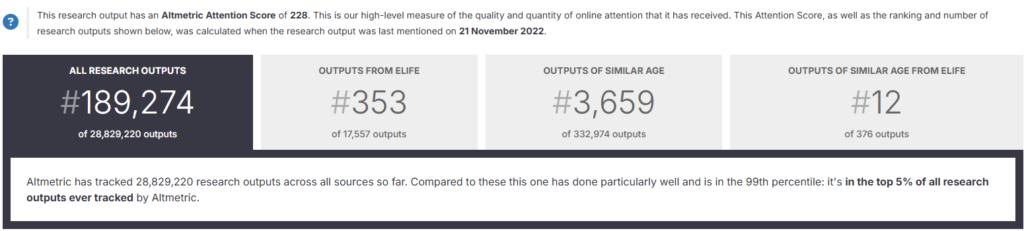
- Attention Score in Context: The article’s score is compared with other similar works. For example, it shows whether it is among the most discussed articles in the same journal, from the same year, or on the same topic, as tracked by Altmetric. This helps put the level of attention it has received into perspective.
Narrative examples:
The article “Optical control of pain in vivo with a photoactive mGlu₅ receptor negative allosteric modulator” has achieved an Altmetric Attention Score of 228, placing it in the top 5 % of all scientific publications evaluated by Altmetric. It stands out particularly for the level of attention it has received, ranking in the 98th percentile among publications of the same age and in the 96th percentile within its source and age group. This score reflects a high level of interest in both academic and non-academic circles.
The article was mentioned in 32 news stories across 29 media outlets, 1 blog, and by 19 users on X (formerly Twitter), reaching a total of 204,862 followers, and was shared on 4 Facebook pages. In addition, it has received 59 academic citations (Dimensions) and has 121 readers on Mendeley, which reinforces its relevance both in the scientific community and in broader public discourse.

PlumX Metrics is a tool that provides insight into the impact of a scientific publication beyond traditional citations. It groups various types of indicators into five main categories, offering a more comprehensive and diverse view of the reach of an academic paper in different contexts, both within and outside the scientific community.
PlumX Metrics
Plum Print
The data is presented visually using Plum Print, a circular chart that intuitively shows the level of impact in each category. The larger each “petal” is, the greater the number of interactions or mentions in that dimension. This representation makes it possible to quickly identify the areas in which a publication stands out: for example, whether it is heavily used, widely shared on social media, or has a high number of citations.
Citations
It includes citations to the publication from other academic works in databases such as Scopus or Crossref. These citations reflect formal recognition within the scientific community.
Usage
It includes direct interactions with the content, such as views, clicks, or downloads. It reflects the interest the article has generated among those who access it.
Captures
Indicates that a person has saved the article for possible future use, for example, in reference managers such as Mendeley. This can be interpreted as a sign of future interest or a potential citation.
Mentions
It tracks the number of times the work has been mentioned in places such as blogs, news articles, Wikipedia, or other public forums. It illustrates how the content circulates and is discussed in broader contexts.
Social Media
It measures the article’s presence on platforms such as X (formerly Twitter), Facebook, and LinkedIn. These metrics indicate immediate visibility and reach on social media channels.
Narrative example:
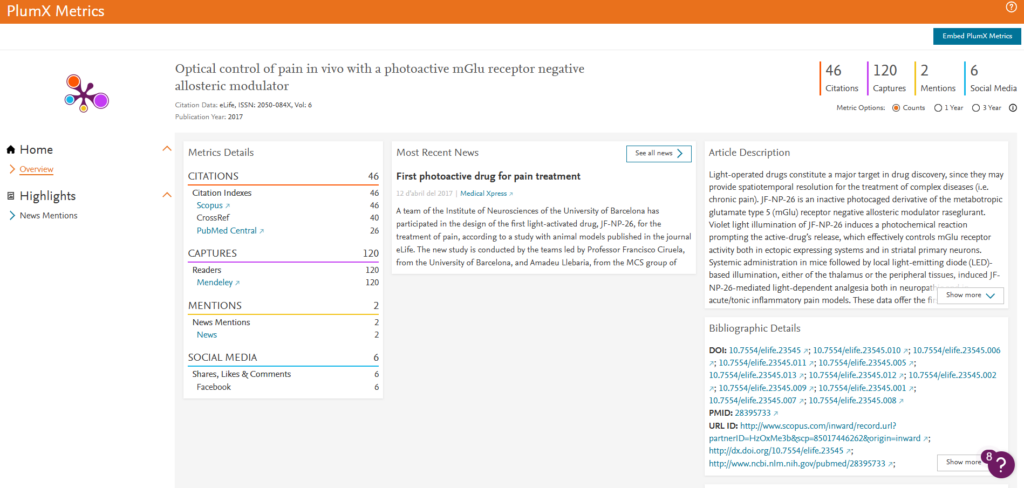
The article “Optical control of pain in vivo with a photoactive mGlu receptor negative allosteric modulator” has accumulated 46 citations in databases such as Scopus, CrossRef, and PubMed Central, and has 120 saves on Mendeley, indicating strong and sustained academic interest. These figures reflect that the study has been used as a reference and has been consulted extensively by other researchers in the field.
In addition, it has received two mentions in news outlets and has been shared on social media, particularly on Facebook (6 interactions). Coverage in media outlets such as Medical Xpress underscores the article’s social and outreach impact, highlighting its contribution to the development of the first light-activated drug for pain treatment. Overall, the data from PlumX reinforces its dual impact: academic and media.
How do Altmetric and PlumX Metrics differ?
While Altmetric uses a single aggregated metric—the Altmetric Attention Score—to summarize the attention received from various sources, PlumX does not condense its information into a single number. Instead, it breaks down the data into separate categories, allowing for a more detailed and balanced analysis of impact.
In terms of integration with academic platforms, PlumX is typically incorporated into databases such as Scopus, as well as institutional repositories and academic journals, facilitating direct access from the environment in which the article is viewed. Altmetric, for its part, is integrated into platforms such as Dimensions, where users can also access its metrics when viewing scientific publications.